폐수처리공학의 근본적인 목표
The Fundamental Goal of Wastewater Treatment Engineering
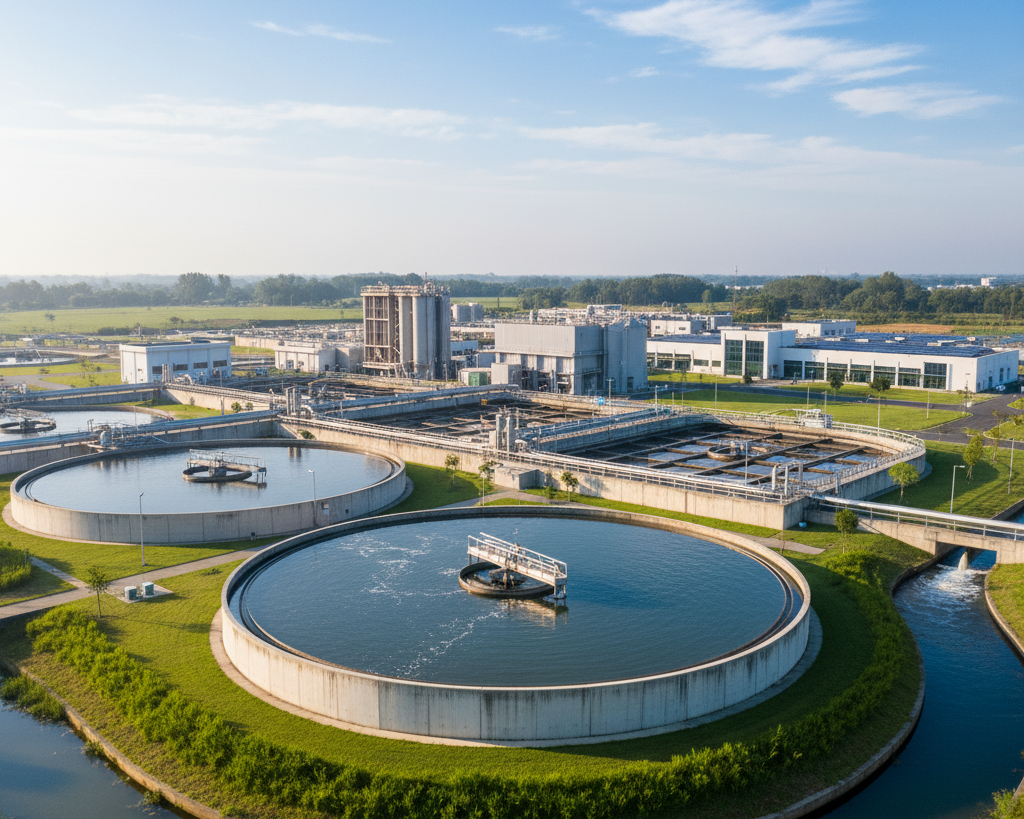
폐수 처리 공학의 궁극적인 목표는 공중 보건 및 환경을 보호하는 것이다. 이를 위해 폐수 내 다양한 오염 물질(유기물, 부유 고형물, 병원균, 미량 오염 물질, 영양소 등)을 효과적으로 제거해야 한다. 폐수 처리 방법의 분류는 단순히 공정을 나열하는 것을 넘어, 처리 목표를 달성하기 위한 과학적 및 공학적 원리를 적용하는 기본 틀을 제공한다.
The ultimate goal of wastewater treatment engineering is to protect public health and the environment. To achieve this, various pollutants within wastewater, such as organic matter, suspended solids, pathogens, and more recently, micropollutants and nutrients, must be effectively removed. The classification of wastewater treatment methods serves as a fundamental framework for applying scientific and engineering principles to meet treatment objectives, rather than simply listing processes.
1. 폐수 처리 분류 체계의 이해
1. Understanding the Wastewater Treatment Classification System
전통적인 처리 분류(1차, 2차, 3차)는 주로 제거 효율의 정도를 나타내며, 그 경계가 임의적일 수 있다. 현대적인 접근 방식은 최종 방류수 수질 목표를 먼저 설정하고, 이를 달성하기 위한 최적의 단위 공정(Unit Process) 조합을 설계하는 것이다.
The traditional classification of treatment (primary, secondary, tertiary) primarily indicates the degree of removal efficiency, and its boundaries can be arbitrary. The modern approach is to first set the final effluent quality target and then design an optimal combination of Unit Processes to achieve it.
단위공정의 과학적 분류 Scientific Classification of Unit Processes
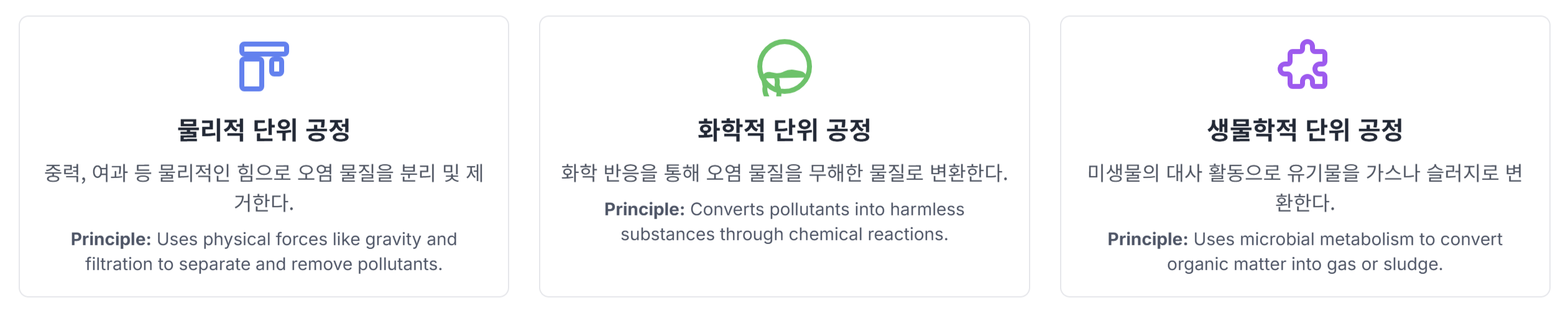
처리 방법은 작용 원리에 따라 다음과 같은 세 가지 핵심 단위 공정의 조합으로 구성된다.
Treatment methods are composed of a combination of three core unit processes based on their principles of action.
1) 물리적 단위 공정 (Physical Unit Process)
- 원리: 중력, 흡착, 여과 등 물리적인 힘을 이용하여 오염 물질을 분리 및 제거한다.
- 주요 공정: 스크리닝(Screening), 그리트 제거(Grit Removal), 침전(Sedimentation), 여과(Filtration)
- Principle: Uses physical forces such as gravity, adsorption, and filtration to separate and remove pollutants.
- Key Processes: Screening, Grit Removal, Sedimentation, Filtration.
2) 화학적 단위 공정 (Chemical Unit Process)
- 원리: 화학 물질을 첨가하거나 화학 반응을 유도하여 오염 물질을 제거하거나 무해한 물질로 변환한다.
- 주요 공정: 응집/침전(Coagulation/Precipitation), 소독(Disinfection), 산화(Oxidation)
- Principle: Removes or converts pollutants into harmless substances by adding chemicals or inducing chemical reactions.
- Key Processes: Coagulation/Precipitation, Disinfection, Oxidation.
3) 생물학적 단위 공정 (Biological Unit Process)
- 원리: 미생물의 대사 활동을 이용하여 생분해성 유기물을 가스나 새로운 세포(슬러지)로 변환하여 제거한다.
- 주요 공정: 활성 슬러지법(Activated Sludge), 살수 여상법(Trickling Filter), 혐기성 소화(Anaerobic Digestion)
- Principle: Uses the metabolic activities of microorganisms to convert biodegradable organic matter into gases or new cells (sludge).
- Key Processes: Activated Sludge, Trickling Filter, Anaerobic Digestion.
2. 처리 수준별 상세 분류 및 적용 단위 공정
2. Detailed Classification by Treatment Level and Applied Unit Processes
처리 단계는 제거 대상 물질과 요구되는 처리 효율에 따라 다음과 같이 체계적으로 분류된다.
The treatment stages are systematically classified according to the target substances for removal and the required treatment efficiency.
| 처리수준 Treatment Level |
주요 목표 및 제거 대상 Primary Goal & Target Pollutants |
핵심 단위 공정(물리/화학/생물) Key Unit Processes (Physical/Chemical/Biological) |
| 예비 처리 (Preliminary) |
후속 공정 보호를 위한 큰 고형물, 협잡물, 모래 등 제거 Removal of large solids, rags, and grit to protect subsequent processes |
물리적 : 스크리닝, 그리트 제거 Physical : Screening, Grit Removal |
| 1차 처리 (Primary) |
부유 고형물(TSS) 및 이와 관련된 유기물(BOD) 일부 제거 Removal of a portion of suspended solids (TSS) and associated organic matter (BOD) |
물리적 : 1차 침전, 부상 Physical : Primary Sedimentation, Flotation |
| 2차 처리 (Secondary) |
용해성 및 생분해성 유기물(BOD)과 잔류 부유 고형물 제거 Removal of soluble and biodegradable organic matter (BOD) and residual suspended solids |
생물학적 : 활성 슬러지, 살수여상 화학적 : 염소소독 Biological : Activated Sludge, Trickling Filter Chemical : Chlorine Disinfection |
| 3차 처리 (Tertiary) |
2차 처리 후 잔류하는 부유 고형물 및 영양소(질소, 인) 제거 Removal of residual suspended solids and nutrients (nitrogen, phosphorus) after secondary treatment |
물리/화학적 : 심층여과, 화학적 인 제거, 막여과 Physical/Chemical : Depth Filtration, Chemical Phosphorus Removal, Membrane Filtration |
| 고도 처리 (Advanced) |
재이용을 목적으로 한 미량 유기물, 용존 고형물(TDS) 등 제거 Removal of trace organics, dissolved solids (TDS), etc., for water reuse purposes |
물리/화학적 : 활성탄 흡착, 이온 교환, 역삼투(RO), 고도 산화(AOPs) Physical/Chemical : Activated Carbon Adsorption, Ion Exchange, Reverse Osmosis (RO), Advanced Oxidation Processes (AOPs) |
핵심 요약 : 일반적으로 1차 처리는 물리적 공정, 2차 처리는 생물학적/화학적 공정, 그리고 3차 및 고도 처리는 물리, 화학, 생물학적 공정의 복합적인 조합으로 구성된다.
Key Summary: Generally, primary treatment consists of physical processes, secondary treatment involves biological/chemical processes, and tertiary and advanced treatments are composed of a complex combination of physical, chemical, and biological processes.
3. 공학적 원리를 통한 공정의 정량적 분석
3. Quantitative Analysis of Processes Through Engineering Principles
모든 단위 공정의 설계와 운영은 공정 분석(Process Analysis)의 기본 원칙을 따르며, 이는 반응기(Reactor) 내에서의 물질 변환을 정량적으로 예측하고 제어하는 것을 목표로 한다.
The design and operation of all unit processes are guided by the fundamental principles of Process Analysis, which aims to quantitatively predict and control material transformations within a Reactor.
가. 반응기 모델링 및 성능 분석 Reactor Modeling and Performance Analysis

반응기 유형 : 폐수 처리에 사용되는 주요 반응기는 다음과 같다.
Reactor Types : The main reactors used in wastewater treatment are as follows:
- 회분식 반응기 (Batch Reactor): 유입과 유출 없이 일정 시간 동안 반응.
- 완전 혼합 반응기 (CMR/CSTR): 유입수가 반응기 내에서 즉시 완전 혼합. (예: 활성 슬러지 폭기조)
- 플러그 흐름 반응기 (PFR): 유체가 혼합 없이 순서대로 흐르는 형태. (예: 염소 접촉조)
- Batch Reactor: Reaction occurs for a set time with no inflow or outflow.
- Complete Mix Reactor (CMR/CSTR): Influent is instantaneously and completely mixed within the reactor. (e.g., Activated Sludge Aeration Tank)
- Plug Flow Reactor (PFR): Fluid flows through in an orderly sequence without mixing. (e.g., Chlorine Contact Tank)
흐름 특성 및 체류 시간 :
Flow Characteristics and Residence Time :
- 이상적 흐름: CMR과 PFR은 이상적인 흐름을 가정하며, 이를 통해 이론적 수리학적 체류 시간(t = V/Q)을 계산한다.
- 비이상적 흐름: 실제 반응기에서는 단락(Short-circuiting), 사수역(Dead Zone), 분산(Dispersion)과 같은 비이상적 흐름(Nonideal Flow)이 발생하여 처리 효율을 저하시킨다.
- 추적자 연구 (Tracer Studies): 이러한 비이상적 거동을 평가하기 위해 추적자(Tracer)를 주입하여 체류 시간 분포(RTD)를 분석한다. 이는 침전조나 소독조의 실제 유효 접촉 시간을 파악하는 데 필수적이다.
- Ideal Flow: CMR and PFR assume ideal flow, which is used to calculate the theoretical hydraulic residence time (t = V/Q).
- Nonideal Flow: In actual reactors, Nonideal Flow conditions such as Short-circuiting, Dead Zones, and Dispersion occur, reducing treatment efficiency.
- Tracer Studies: To evaluate this nonideal behavior, Residence Time Distribution (RTD) is analyzed by injecting a tracer. This is essential for determining the actual effective contact time in sedimentation tanks or disinfection basins.
나. 반응 속도론과 설계 효율
b. Reaction Kinetics and Design Efficiency
- 질량 수지 분석 (Mass Balance) : 모든 반응기 설계의 기초이다. 정상 상태(Steady-State)에서는 축적률을 0으로 가정하고, 화학양론(Stoichiometry) 및 반응 속도론(Kinetics)을 고려하여 설계 변수를 도출한다.
- Mass Balance : This is the foundation of all reactor design. Under Steady-State conditions, the accumulation rate is assumed to be zero, and design variables are derived by considering Stoichiometry and Reaction Kinetics.

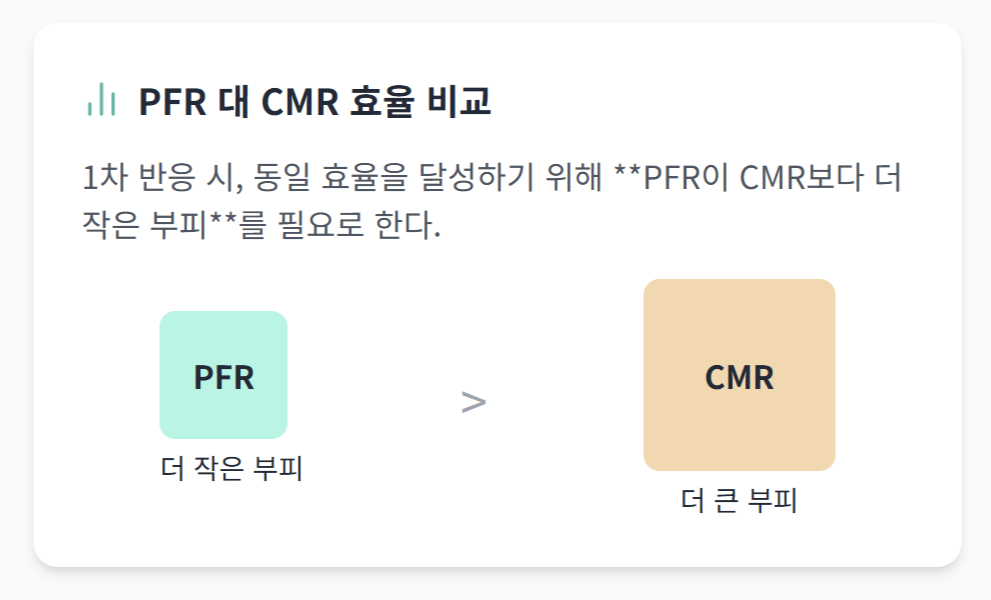
- PFR 대 CMR 효율 비교: 1차 반응(rc=-kC)을 따르는 오염 물질 제거 시, 동일한 제거 효율을 달성하기 위해 플러그 흐름 반응기(PFR)가 완전 혼합 반응기(CMR)보다 더 작은 부피를 필요로 한다. 이는 PFR이 반응기 초입부의 높은 농도를 효율적으로 활용하기 때문이다.
- PFR vs. CMR Efficiency Comparison : For removing pollutants that follow first-order kinetics (rc=-kC), a Plug Flow Reactor (PFR) requires a smaller volume than a Complete Mix Reactor (CMR) to achieve the same removal efficiency. This is because a PFR effectively utilizes the high initial concentration at the reactor inlet.
- 분산 모델링 : 축 방향 분산 모델(Axial Dispersion Model)을 통해 비이상적 흐름을 정량화할 수 있다. 분산이 클수록(분산 수 d가 큼) PFR의 성능은 이상적인 상태보다 저하된다.
- Dispersion Modeling : Nonideal flow can be quantified using the Axial Dispersion Model. The greater the dispersion (larger dispersion number, $d$), the lower the performance of the PFR compared to its ideal state.
다. 설계 조건의 통계적 설정
c. Statistical Determination of Design Conditions
처리 시설의 용량과 성능을 결정하는 설계 조건(Design Conditions), 즉 설계 유량 및 질량 부하율(Mass Loading Rate)은 폐수 유입 데이터의 통계적 분석을 통해 설정된다. 평균, 표준편차뿐만 아니라 데이터의 왜도(Skewness)를 분석하여 정규 분포 또는 로그 정규 분포 등 적절한 확률 분포 모델을 결정하고, 이를 바탕으로 신뢰도 높은 설계 기준을 마련한다.
The Design Conditions that determine the capacity and performance of a treatment facility, namely the Design Flow Rate and Mass Loading Rate, are established through statistical analysis of influent wastewater data. By analyzing not only the mean and standard deviation but also the Skewness of the data, an appropriate probability distribution model (e.g., normal or log-normal) is determined to establish reliable design criteria.
결론 Conclusion
폐수 처리 방법의 분류는 처리 목표를 설정하는 유용한 지침이다. 그러나 성공적인 처리 시설의 설계와 운영은 각 단계에 포함된 단위 공정들을 물리, 화학, 생물학적 기본 원리와 반응기 모델링, 질량 수지, 반응 속도론과 같은 엄격한 공학적 분석 방법론을 통해 정량적으로 이해하고 최적화할 때 비로소 가능하다.
The classification of wastewater treatment methods is a useful guide for setting treatment goals. However, the successful design and operation of treatment facilities are only possible when the unit processes at each stage are quantitatively understood and optimized through rigorous engineering analysis methodologies, including fundamental principles of physics, chemistry, and biology, as well as reactor modeling, mass balance, and reaction kinetics.

